Health Records Reinvented: What Happens When Clinicians Are in the Driver's Seat
No vendor lock-in. Workflows that save time instead of stealing it. One system that scales from a solo clinic to a national network. And AI assistants as first-class citizens — made safe to use. An essay on what clinicians actually need from an electronic health record, and how Cairn is designed to deliver it.
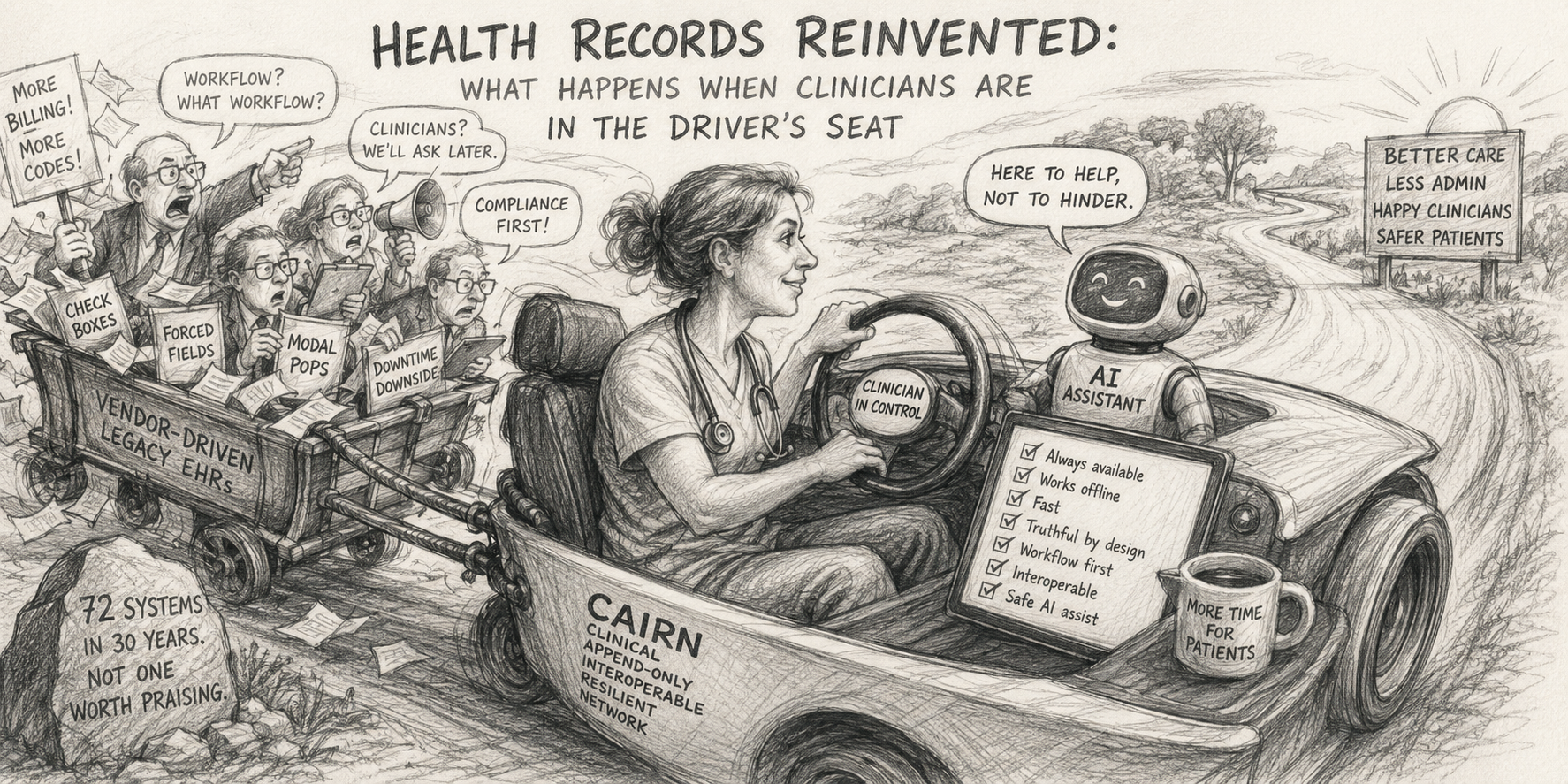 Clinician in the driver's seat — image generated with AI by the author's prompt
Thirty years, seventy-two systems
I have worked as a clinician in multiple countries for more than thirty years — from tertiary hospitals in Germany, Norway, and Australia to remote Indigenous clinics and refugee camps in Papua New Guinea. I have worked as a surgeon, in rural and remote general practice, and for the past decade mainly in emergency medicine in remote hospitals.
Wherever I worked, there were "electronic health records". They came in many varieties and behind many user interfaces, but all of them — in every country and every setting — had one thing in common: they were mostly unfit for clinical purpose. Not one of them fully supported the clinical workflow. The best merely slowed us down compared to paper and were a nuisance; the majority forced us to record untruthful data, made our work materially harder, and put our patients at risk.
I remember one number: 72. That was the tally, the last time I counted, of the different record systems I had used in my career. I stopped counting a few years ago. I will not name and shame any particular product, because they should all hang their heads collectively: not a single one, in thirty years, has deserved praise from an experienced clinician.
This is puzzling, because computerised records have undeniable advantages over paper. Legibility, first and foremost — provided the interface doesn't make finding anything next to impossible. Distribution: a record can be up to date in several places at once. And automated assistance: knowledge support, dose checking, quality control that no paper chart can offer. The raw material for something wonderful has been sitting there for decades. So why do clinicians mostly hate the result?
One root cause stands out. Most of these systems are designed for — and often by — administrators and managers: people far removed from the clinical front line, and generally as clueless about clinical workflows as clinicians are about administrative requirements. Two worlds, far apart, with only a small intersection. Some vendors keep a "token clinician" on board during the (usually late) design phase; most pretend to take our advice and then quietly ignore it. The result is faithful to its origins: a billing and audit instrument with a clinical veneer, handed to the one profession that was never really in the room.
This essay is my answer to a simple question: what would the record look like if clinicians had been in the driver's seat from the first line of code? The first half is the demand — what we want, and what the ideal system would look like. The second half is the response — how Cairn, an open-source health record architecture we (clinicians who also code) are building with exactly this question as its founding brief, answers each demand not with a feature promise but with a structural design decision.
What clinicians want from an EHR
None of these are luxuries. Every one of them is something paper already gave us, or something a computer could trivially give us if anyone had asked.
- It must be available all the time. No downtime because the power failed or the network dropped. A record system that goes dark takes the whole department with it.
- It must not be slower to use than paper. Every extra minute at the keyboard is a minute taken from a patient.
- It must not prevent us from doing anything we can do on paper — with the sole exception of malfeasance, such as forging a record or silently backdating one.
- It must exchange data with the systems other clinicians use — without extra work, without loss, without corruption.
- It should be better than paper where computers genuinely help: dose and interaction checking, calculations, up-to-date guidelines — delivered inside our workflow, not in a separate module we have to go and visit.
- It must never force us to record a precise untruth. No modal dialog may extort a diagnosis code, a date, or a dose that we cannot honestly vouch for as the price of saving our work.
- It must support our workflow rather than load extra cognitive work onto us. We hold a patient's story in our heads while we work; every screen that makes us re-derive context is a screen that risks losing part of that story.
- It must never lock us out of the record while we are writing it. Modal dialogs are the enemy of correct and concise documentation. I have used systems that would not let me view a lab report next to the progress note I was writing — systems where looking something up meant either losing the text I had already entered, or navigating a labyrinth of menus and finding my way back. On paper I simply lay the report beside my note. Software must do at least that well.
- It must be intuitive. If a locum cannot use it safely on their first shift, it is not a clinical tool; it is a training burden.
And two more that paper never gave us, but that three decades of watching electronic systems fail have added to the list:
- It must make identity errors survivable. Records get attached to the wrong patient; two patients get merged who are not the same person. In most systems these mistakes are somewhere between painful and impossible to undo. They must be fully repairable — with an audit trail and with zero data loss.
- It must belong to no one but the people it serves. Not to a vendor who can hold the data hostage at contract renewal, not to a cloud whose outage is our outage, not to a company whose acquisition ends the product.
Vendors can make their legitimate money by crafting and polishing specialised user interfaces, by providing training & support services and hardware provisioning — but never by installing any toll gates or limitations on the infrastructure that drives interoperability, safety, and confidentiality.
What the ideal EHR would look like
Take those demands seriously and a picture emerges.
It runs and performs well on whatever hardware is available at the point of care. In most hospitals, clinicians queue and squabble for workstations, because workstations cost money (the hardware and the per-seat licences) and they occupy space and power that clinical rooms don't have. Software that runs on cheap & tiny, power-frugal computers, the kind a small UPS can carry through a whole day's outage, changes that arithmetic completely.
It keeps working when the network doesn't — the way email does. Everything already on the local node stays readable; new documentation keeps flowing; and when the connection returns, the nodes synchronise. Reliably, automatically, with no human intervention and no "sync conflict" dialog asking a nurse to adjudicate a distributed-systems problem at 3 a.m.
It lets clinicians document in their own language, in their own words, in their own style. It never forces an imprecise truth into false precision, and never forces a falsehood at all.
I have worked with systems that made us pick a diagnosis from a fixed list before the record would save — and when the correct diagnosis, or anything remotely near it, was not on the list, we picked a wrong one, because the alternative was losing the note. Those consistently wrong diagnoses then "informed" public-health statistics and funding decisions. Garbage in, garbage out, and at the end of that chain: poorer care at higher cost, built on data everyone involved knew was false the moment it was entered.**
It facilitates the workflow instead of interrupting it. Clinical dashboards that show exactly the information the current decision needs, at the moment it is needed. Dosing insulin? Show me the trajectory of blood sugars against the insulin already given, most recent first, alongside the handful of parameters that actually bear on the decision — the HbA1c as the marker of long-term control, existing complications, the co-medication that alters glucose or insulin response. That is not artificial intelligence; it is elementary respect for how clinical decisions are made.
It shares the record with everyone else caring for the patient — seamlessly and without ceremony. When my patient leaves hospital, their family doctor can already read my actual notes, rather than waiting weeks for a discharge summary written retrospectively by an intern who never met the patient. And when a patient arrives in an emergency department anywhere, the treating physician sees the history immediately — not after a records clerk wakes up in the morning.
It keeps the patient's trust while keeping the patient safe. Confidentiality and clinical safety pull in opposite directions — the sensitive episode a patient wants sealed may be exactly the fact a future clinician needs to be warned about. The ideal record refuses to sacrifice either.
And it lets machine assistance in — on our terms. AI that drafts, summarises, cross-checks, and flags is coming to clinical work whether the record systems are ready or not. The ideal record neither bans it nor blindly trusts it: machine contributions are welcome, permanently labelled as what they are, and structurally incapable of corrupting the record — with accountability that always, traceably, rests with an identifiable human who accepted responsibility.
That is the demand side. Now the response.
How Cairn answers — design decisions, not feature promises
Cairn is an offline-first, vendor-independent electronic health record, developed in the open under the AGPL-3.0 licence. Its architecture specification is complete — every open design question has been resolved and logged in an immutable decision record — and its hardest technical bets have been validated in working code before any product was built on top of them. The first clinical slices are under construction now.
What makes Cairn different is not a feature list. Features can be promised by anyone and removed by the next product manager. Cairn answers each clinical demand with a structural decision — a property of the architecture that cannot be quietly walked back later. Here is the mapping.
1. Always available, because every node is the whole system
When a network partitions, a system must choose: stay consistent, or stay available. Cairn chooses availability, unconditionally. A clinician must always be able to read the locally relevant record and write new documentation, network or no network — because paper never returns "connection lost", and no system that does can claim to replace it.
That choice has consequences, and Cairn embraces them. There is no central server that owns the truth. Every node — a workstation, a clinic, a hospital, a regional hub — carries a full, working copy of the system and of the records relevant to it. The topology is fractal: one codebase at every tier, from a single machine in a bush clinic to a national network; a node's role is configuration, not a different product. Synchronisation between any two nodes is mathematically safe by construction (more on that below), so reconnection after an outage is a non-event, not a recovery procedure.
And because the whole system runs in one codebase on commodity hardware, "whatever is available at the point of care" is taken literally: a complete Cairn node has been demonstrated running on a Raspberry Pi — a computer the size of a pack of cards that a small UPS can power for a day — and its database layer has been run on an ordinary Android phone. Synchronisation has been validated over a real satellite link with nearly a second of round-trip delay — and not a laboratory simulation of one. The two nodes were my laptop in hospital accommodation in Bamaga, at the northern tip of Cape York, and a machine at my home some 2,400 kilometres south on the New South Wales coast: WireGuard over Starlink at both ends — a residential dish at the southern end, and at Bamaga a Starlink Mini lying unfastened on the roof while a storm blew through. If sync shrugs that off, a hospital basement holds no terrors. These are not projections; they are passed tests.
2. Never slower than paper — paper-parity as law
Cairn elevates the speed demand from an aspiration to a governing law: no clinical workflow may be slower, harder, more cognitively demanding, or less capable than its paper equivalent. The only excluded paper "capabilities" are the fraudulent ones such as silent falsification, untraceable backdating. Every new workflow must name its paper counterpart and be benchmarked against it in time, steps, and cognitive load.
One consequence deserves special mention, because it breaks with two decades of lazy convention: confirmation dialogs are explicitly rejected as a safety mechanism. A clinician who is interrupted a hundred times a day learns to click "OK" reflexively; the dialog provides legal cover, not safety, and it fails the paper benchmark every single time. Where software has a safety problem — documenting on the wrong chart, say — Cairn's rule is to restore the physical affordance that made the error hard on paper (you were holding one specific folder), not to interrogate the user.
3. Never a forced untruth — uncertainty as a first-class value
Cairn's data model is built on a principle it states baldly: an imprecise near-truth always beats a precise untruth. Uncertainty, imprecision, ranges, and an explicit unknown (distinct from not yet asked, and distinct again from the patient declined to say) are first-class recordable values everywhere. No required field, anywhere in the system, may be satisfiable only by fabrication. The mandatory diagnosis picker with no honest option is not permitted in Cairn: it is a violation of the architecture.
Time — the thing most systems most cheerfully falsify — gets the full treatment. Every event carries two timestamps: the objective moment it was recorded, and the clinically asserted time it refers to ("the chest pain started around midnight"). The asserted time is freely backdatable, because honest documentation demands it; the recorded time is tamper-evident, because honest auditing demands that too. Where the two tell conflicting stories, the conflict is flagged for a human — never silently "resolved" by the machine.
Certainty, when it improves, is added later by overlay. It is never extorted up front.
Honest time has one more enemy: the clocks themselves. Every computer's clock drifts, and a node that has been offline for a week — precisely the situation Cairn is built for — may drift far, or be flatly wrong. A record system that orders events by wall-clock alone will, sooner or later, show a treatment given before the assessment that prompted it, purely because two machines disagreed about what time it was. Cairn therefore orders events by a hybrid logical clock: each event's stamp combines the writer's wall-clock with a counter that tracks what that writer had already seen. The effect is a guarantee no wall-clock can give — if a note was written by someone who had already read an earlier note, it sorts after that note, on every node, forever, no matter whose clock was fast or slow. Wall-time keeps the stamps humanly meaningful when the clocks are behaving; the causal counter keeps the story in the right order when they are not. And because the stamp needs no time server and no coordinator, it works exactly where it is needed most: on the node that has not spoken to anyone in days.
4. Identity errors are survivable — never merge, always link
Nothing is ever lost — and everything stays readable. Every clinical entry in Cairn is an immutable, cryptographically signed event. Corrections do not overwrite — they are new events that reference what they correct, so the record always shows both what is believed now and what was believed at the time, and by whom. This is exactly the paper discipline of the single ruled-through line with initials, made rigorous: never erase, always overlay.
This is also, quietly, the mechanism that makes synchronisation trustworthy. Because events are immutable, merging two nodes' histories is a set union — each side simply acquires the events it was missing. Set union cannot conflict, cannot lose data, and gives the same answer no matter how many times, in what order, or over how flaky a link it runs. The most dangerous operation in distributed health records — the merge — is engineered out of existence.
And because a record is only as good as its readability decades from now, every event carries a plain-text rendering of itself, and the data schema is only ever extended, never broken: a record written today must still be legible, as written, to whatever software — or whatever human — reads it in fifty years.
In Cairn, patient identity is treated as what it clinically is: a claim, never a fact. Records are never merged into one another; they are linked by explicit, signed, auditable identity events — and every one of those events can be countermanded by a later one. Linked in error? Unlink, with the reason on the record. A document attached to the wrong patient? Reattribute it, auditable, reversible, with nothing lost. The identity mistakes that in conventional systems demand a vendor ticket and a prayer are, in Cairn, ordinary auditable events that any authorised clinician can apply and any later clinician can inspect.
5. Exchange without friction — one record, many front-ends
Cairn inverts the interoperability problem. Conventional systems are walled gardens that grudgingly exchange summaries through interface engines; every fence between them is a place where data is lost, mangled, or delayed.
In Cairn, what makes any two nodes interoperable is the signed event core itself — the wire format, the sync rules, the identity algebra — and nothing above it. No API, no policy layer, no user interface sits on the path between nodes.
The safety and compatibility floor is enforced in the database itself, unbypassably: even software talking raw SQL to a node cannot produce an invalid or wire-incompatible event. Above that floor, user interfaces may proliferate freely — an emergency department UI, a general-practice UI, a bespoke UI for a single specialised clinic — many front-ends, one record. A badly designed front-end can produce a note its clinic finds unhelpful; it cannot produce a record another node can't read.
This is what dissolves the discharge-summary farce. When hospital and family doctor both run Cairn nodes, the family doctor's node simply syncs the actual notes as they are written — the "summary" becomes a courtesy narrative, not the sole carrier of truth. And for the world outside the mesh, Cairn speaks standard FHIR through a dedicated façade — interoperability with the systems that exist, without letting their limitations dictate the internal model.
6. Decision support that fits the workflow — and can't corrupt the record
That insulin dashboard — trajectory of glucose against doses given, the HbA1c, the complications, the interfering co-medication, exactly when the dosing decision is being made — is precisely the kind of thing Cairn's layering is built to make cheap. Dashboards, checkers, and calculators live above the enforcement floor: they read the same event stream everyone else does and they write through the same validated gate everyone else must use.
A hospital, a research group, or a single motivated registrar can build the decision-support view their unit needs, without asking a vendor's permission and without any possibility of breaking the record underneath. The record is infrastructure; the workflow tooling on top is a garden anyone may plant in.
7. Confidential and safe — not one at the other's expense
Cairn refuses the usual trade. A patient may seal a sensitive episode — the content becomes cryptographically inaccessible without the appropriate key custody. But a sealed episode that carries future clinical risk still emits a de-identified, severity-graded safety projection: the warning without the story.
The antenatal clinician is told there is a sensitisation risk that matters for this pregnancy — not the confidential history behind it (the classical case where a rhesus-factor sensitisation risk exists: the clinician does not need to know whether it was due to a past pregnancy termination, a miscarriage, or whatever — stigma and bias can be avoided where patient preferences or cultural or legal contexts would compromise clinical care). Emergency access ("break-glass") is not a hole in the wall but an audited use of a key: possible when it must be, and permanently on the record that it happened.
Even the right to erasure is honoured within the append-only design: erasure is implemented as the destruction of encryption keys — provable, auditable, and honest about exactly what it does and does not guarantee.
8. AI assistants as first-class citizens — made safe to use
Most record systems will bolt AI on the way they bolted everything else on: as an afterthought, with the accountability questions waved away. Cairn was designed for it from first principles, starting with an honest one: authorship and accountability are not the same thing. Every contributor to a note — human or machine — is recorded in the event itself, permanently. But responsibility is a separate, explicit act: a signature proves who produced content; an attestation records who vouches for it.
An AI draft is labelled as an AI draft forever, and the human who reviewed and accepted it is on the record as having done so. No laundering of machine output into apparent human prose; no ambiguity, years later, about who stood behind a decision.
The machine itself is held to a standard no human clinician could be: an AI assistant in Cairn is a registered actor whose identity is pinned to the exact model and configuration it runs — change the model, and it is a different actor. If a model version is later found to be flawed, every contribution it ever made is identifiable and can be flagged for review in one sweep — a recall mechanism, exactly as medicine already does for a faulty batch of a drug.
And the floor holds. Because validation lives unbypassably in the database, an AI agent — however capable, however misbehaving — physically cannot forge another author's signature, alter history, or write around the record's rules. This is not a policy statement; it was tested by red-teaming: a deliberately hostile agent, granted direct database access, could not break the contract. That is what "first-class citizen, made safe" means: not a chat window bolted to the side, but a colleague with a name tag, a scope of practice, and no ability to falsify the chart.
9. No lock-in — by construction, not by promise
Every mechanism above serves a mission that is explicitly anti-capture, and the project's own governance is built to the same standard. The entire codebase is AGPL-3.0 — every improvement, including improvements made by commercial operators, must remain open. The specification and every design decision are public. The data lives in PostgreSQL on hardware you own; there is no mandatory cloud, no licence server, no per-seat meter. The full architecture documentation means a competent team could re-implement the system from the documents alone — which is precisely the point: the exit door is a load-bearing part of the building. A vendor cannot hold hostage what, by construction, no vendor controls.
Where this stands, and an invitation
I want to clarify the project's status because health IT has heard enough vapourware promises. Cairn today is a completed, published architecture, a set of passed proof-of-concept trials for its riskiest bets (synchronisation over a genuine high-latency satellite link, a full node on a Raspberry Pi, the database layer on an Android phone, the write-contract floor held against a hostile AI agent with direct database access) and the first production clinical components now being built on that proven spine, slice by slice, in the open.
It is not yet a product you can deploy in your hospital. It is the foundation for one, built in the right order: the hard, unforgiving, safety-critical parts first, validated before anything was stacked on top of them.
The design method that got it this far is one we intend to keep: take a real clinical failure — ours, or one a colleague or patient brings — and test it against the architecture until the architecture either absorbs it or bends. Seventy-two systems taught me where the bodies are buried. If you have worked the front line, you know where more of them are. Bring them to us.
So this is the invitation.
- If you are a clinician: bring your worst war stories: the workflow that made you slower, the dialog that made you lie, the merge that could not be undone. They are design input of the highest grade, and they are exactly what this project runs on.
- If you are an engineer: the specification, the decision log, and the code are public, and the problems are as hard and as worthwhile as any in software. Tell us about your experiences — what worked and what didn't, and what you would do differently now. You are welcome to get your hands dirty on our code!
- If you are an administrator: you are genuinely welcome too. The record that serves clinicians honestly turns out to serve you better as well: data that was never falsified at entry is the only data worth funding decisions downstream.
- If you are a funder: we cannot promise (or even suggest) that a contribution will ever yield a direct financial return. There is no equity to hold and no license revenue to share; the license is deliberately built so that nobody, including us, can ever capture this project. The return arrives elsewhere: in clinician time given back to patients, in workplace satisfaction of expensive professionals, in labour costs avoided, in clinical and administrative errors that never happen — savings on a scale open to every entity that adopts the system precisely because no vendor stands between them and it — and, beyond all of that, in health outcomes. If that is a payoff you can accept, contributions that speed this project up are very welcome. We are clinicians who code, and the scarcest resource here is our time: financial support that frees us from some shifts converts directly into deliverables.
For thirty years I have used systems built by people who never had to use them at three in the morning. Cairn is what happens when the people who do take the wheel.
Cairn is developed in the open at github.com/cairn-ehr/cairn-ehr, AGPL-3.0. The specification, the decision log, and the companion essays on this site go as deep as you care to follow.